• Skip to main content
  • Skip to header right navigation
  • Skip to site footer

InsideProduct

Just in time resources for internal products

  • About
  • Newsletter
  • Resource Hub
    • Newsletter Archive
    • Guides
    • Presentations
    • Books
    • Courses

About

Newsletter

Newsletter Archive

Guides

Presentations

Books

Courses

Technique Brief

Personas

August 22, 2017 by Kent McDonald

What is a Persona? A persona defines a typical user of a product. They help you understand the context in which people use the product to help guide your design decisions. Personas originated from Alan Cooper’s work on user-centered design. An Example Below is an example persona for the Agile Alliance Submission System. Reed the …

Read morePersonas

Commitment Scale

August 16, 2017 by Kent McDonald

What Is the Commitment Scale? The commitment scale is a stakeholder analysis technique. This technique gauges the current level of stakeholder commitment to a project, as well as what level of commitment is needed to ensure the project’s success. An Example of the Commitment Scale A team working on a commission system created their stakeholder …

Read moreCommitment Scale

Stakeholder Map

August 2, 2017 by Kent McDonald

What Is a Stakeholder Map The stakeholder map is a technique commonly used for stakeholder analysis. Using the stakeholder map to guide conversations helps a team understand who the stakeholders for the project are, understand key characteristics about those stakeholders, and identify plans for engaging the stakeholders on an ongoing basis. Primary outcomes from a …

Read moreStakeholder Map

Value Based Decision Making

June 7, 2017 by Kent McDonald

What Is Value Based Decision Making Value-based decision making is a method for making critical organizational decisions in an informed and timely manner. Use this tool to identify the most critical decisions you face, determine when to decide, and figure out what information you need to best make those decisions. Because critical decisions often directly …

Read moreValue Based Decision Making

Collaborative Modeling

April 19, 2017 by Kent McDonald

What Is Collaborative Modeling Collaborative modeling refers to the use of well-known requirements analysis and modeling techniques in a collaborative fashion to build and maintain a shared understanding of the problem space and the potential solution. The main premise is that requirements models, which have long been viewed as documentation techniques, can also be put …

Read moreCollaborative Modeling

User Modeling

April 11, 2017 by Kent McDonald

Following is a slightly edited excerpt from Beyond Requirements: Analysis in an Agile Mindset What It Is A user is anyone who receives value from a product. Users include people who directly interact with the product as well as those who do not directly interact with the product but receive some value from it. User …

Read moreUser Modeling

Socratic Questioning

February 22, 2017 by Kent McDonald

What Is Socratic Questioning Socratic questioning is a dialog structured by a series of questions intended to draw out answers. First establish a thesis of what your stakeholder thinks their need is (usually expressed as a solution). Then engage in a dialog structured as a series of questions in an attempt to refute or disprove …

Read moreSocratic Questioning

Risk Management Game

December 29, 2016 by Kent McDonald

What is the Risk Management Game? The risk management game is a collaborative way for your team to identify risks that you face, categorize those risks based on impact and probability, and determine which risks to address first. The game was originally created by Ken Clyne based on Steve Bockman’s Team Estimation game. Here’s an …

Read moreRisk Management Game

Problem Statement

December 7, 2016 by Kent McDonald

What It Is The problem statement is a structured set of statements that describe the purpose of an effort in terms of what problem it’s trying to solve. An Example Since the most important part of this technique is the conversations that occur rather than the end product, I’d like to relay a story about …

Read moreProblem Statement

Acceptance Criteria

July 15, 2015 by Kent McDonald

What Are Acceptance Criteria Acceptance criteria are the conditions that a solution must satisfy to be accepted by a user, a customer, or, in the case of system-level functionality, the consuming system. They are also a set of statements, each with a clear pass/fail result, that specify both functional and nonfunctional requirements and are applicable …

Read moreAcceptance Criteria

Decision Filters

January 2, 2013 by Kent McDonald

Organizations are impacted on a daily basis by decisions made by people at every level. Even the most minute seeming tactical decisions can have an impact on the overall organization. Successful organizations realize this and look for ways to align the decision making at all parts of the organization so that the people who are …

Read moreDecision Filters

Business Value Model

February 18, 2012 by Kent McDonald

Business value is a conversation, not a number. What It Is The business value model is a technique for making critical organizational decisions in an informed and timely manner. Teams using this tool identify the most critical decisions they face, determine when they need to make those decisions, and figure out which information they need …

Read moreBusiness Value Model
Constraints Matrix

Constraints Matrix

February 18, 2012 by Kent McDonald

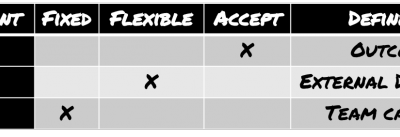
It’s not quite a 2×2, but it’s still very helpful. What It Is The constraints matrix is a quick way to show the relative importance of a set of constraints facing a project team. Each row represents a general constraint faced by most teams. The most common set to use are: Cost, Time, and Scope …

Read moreConstraints Matrix

Purpose Based Alignment Model

February 18, 2012 by Kent McDonald

What is the Purpose Based Alignment Model? The Purpose Based Alignment Model, created by Niel Nickolaisen, is a method for aligning business decisions and process and feature designs around purpose. The purpose of some decisions and designs is to differentiate the organization in the market; the purpose of most other decisions is to achieve and …

Read morePurpose Based Alignment Model
  • Previous
  • Page 1
  • Page 2
Newsletter

Get a regular email with hand-picked resources for product people working on software they use in their own organization.

Subscribe

  • LinkedIn

Copyright © 2026 · All Rights Reserved · Powered by Mai Theme